

The Best Dive Sites in Makadi Bay

Makadi Bay sits 30 kilometres south of Hurghada and has been one of the most popular diving destinations on the northern Red Sea for years — for good reason. The bay packs an unusually wide range of dive sites into a compact area: shallow coral gardens for beginners, deeper reef walls for experienced divers, a wreck, and in Somagarden one of the finest coral pinnacles in the region.
As a PADI 5-Star dive centre in Makadi Bay, we run boats to these sites daily — some are five minutes away, others take thirty. Here is what actually awaits you at each one.
Overview: Makadi Bay Dive Sites
| Dive Site | Depth | Level | Highlight |
|---|---|---|---|
| Gota Abu Ramada | 8-25m | All levels | Fish density |
| Fort Arabesque House Reef | 5-20m | All levels | Beach entry |
| Somagarden | 10-30m | OW upwards | Coral pinnacles |
| El Mina Wreck | 12-28m | OW upwards | Wreck + reef |
| Abu Hashish Lagoon | 3-12m | Beginners | Calm lagoon |
| Ras Disha | 18-35m | Advanced | Current, sharks |
| Salem Express | 10-30m | OW upwards | Historic wreck |
| Abu Ramada South | 8-20m | All levels | Coral garden |
| Grand Coral | 12-25m | OW upwards | Large coral structure |
| Sharm El Arab | 10-25m | All levels | Sandy bottom, rays |
1. Gota Abu Ramada — the most-visited site
Gota Abu Ramada is the classic Makadi Bay dive — a free-standing coral pinnacle that rises from the sandy bottom and is covered in marine life on every side. The name "Gota" is simply Arabic for coral head, and that describes it well: a dense, rounded coral structure around which fish congregate in impressive numbers.
What to expect: large schools of anthias and glassfish circle the pinnacle almost constantly. Napoleon wrasse patrol the base. In good visibility you can see additional coral heads surrounding the main structure. Current is usually minimal, making it suitable for all levels — from newly certified Open Water Divers to experienced photographers hunting macro subjects.
Depth:         8–25 metres
Current:       Minimal to none
Visibility:    15–25 metres
Level:         From Open Water Diver
Boat ride:     20–30 min from Madinat Makadi
2. Fort Arabesque House Reef — straight from the beach {#fort-arabesque}
The house reef at the Fort Arabesque hotel is one of the few Makadi Bay sites accessible directly from the beach — no boat, no waiting, any time of day. That makes it ideal for night dives, spontaneous dives between main excursions, and family snorkelling sessions.
What to expect: the reef begins shallow and drops over a stepped structure to around 20 metres. For a house reef, the species count is impressive — turtles are spotted regularly, octopus hide among the coral heads, and activity picks up significantly in the evenings. For a full comparison of house reefs across the Red Sea, our 2026 house reef guide covers every major location.
Depth:         5–20 metres
Current:       None
Visibility:    12–20 metres
Level:         All levels, ideal for beginners
Entry:         Direct from the beach (no boat)
3. Somagarden — Makadi Bay's best-kept secret {#somagarden}
Somagarden, also known as Abu Soma Garden, is an open secret among divers in the know. The site sits north of Makadi Bay near the Soma reef line — about 20 to 25 minutes by boat. What makes it exceptional: a dense cluster of healthy coral heads with a species diversity that is hard to match at comparable sites in the area.
What to expect: eagle rays pass regularly along the reef edge. The coral coverage is unusually intact — minimal bleaching, dense gorgonian fans in the deeper sections. Underwater photographers find nudibranchs, lionfish and well-camouflaged stonefish here. On a good day, Somagarden is simply one of the most beautiful dive sites north of Marsa Alam.
Depth:         10–30 metres
Current:       Light to moderate
Visibility:    15–28 metres
Level:         From Open Water Diver
Boat ride:     20–25 min
4. El Mina Wreck — the wreck on the doorstep
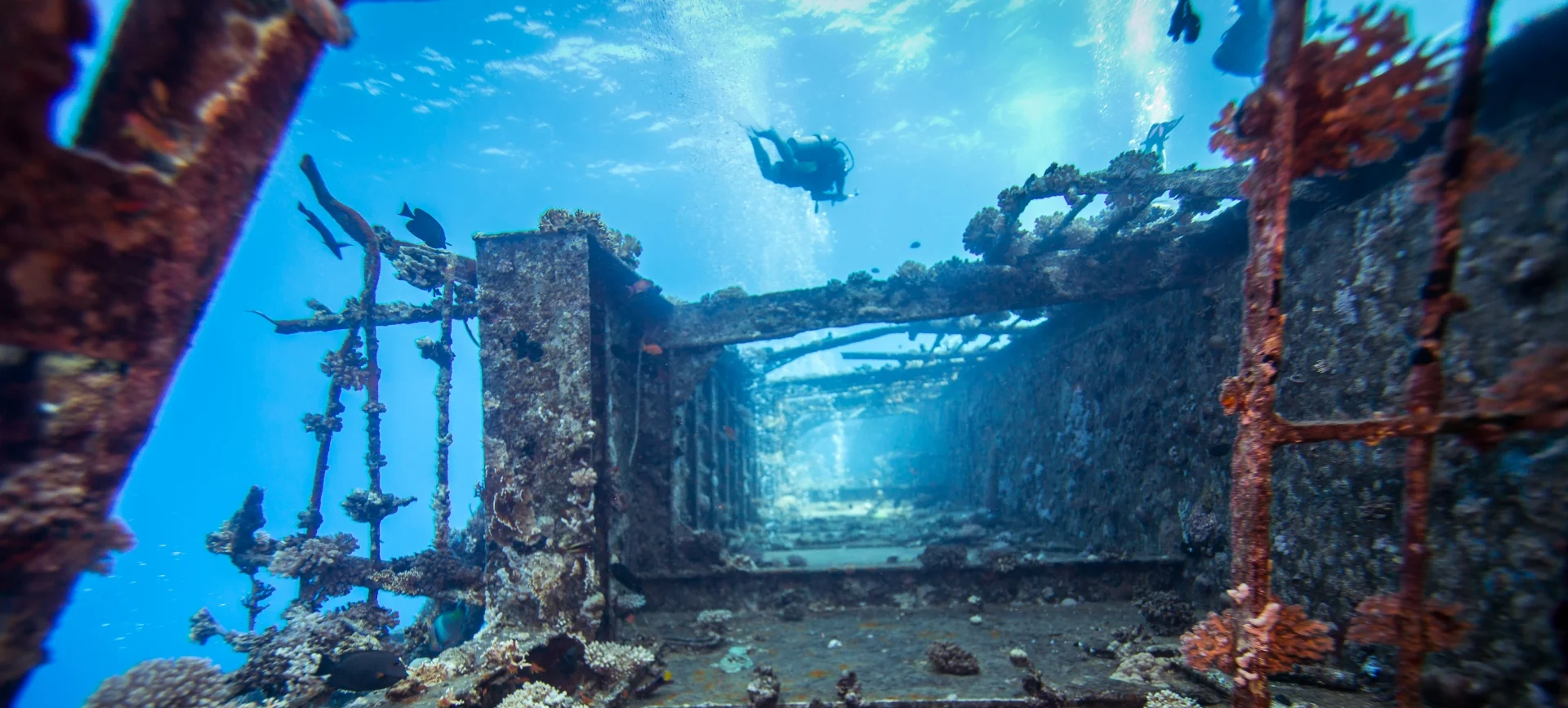
El Mina is a sunken cargo vessel resting at 12 to 28 metres and now one of the most dived wrecks in the Makadi Bay area. It sits upright and largely intact — with clear structures that are accessible even without wreck specialisation.
What to expect: the entire hull is colonised by soft corals. Inside the wreck — for divers with Advanced Open Water certification or wreck experience — several sections can be explored. Outside, large barracuda and trevally patrol the structure. A compelling wreck that still reveals new details on the third visit.
Divers looking for deeper wreck diving should also consider the Salem Express — one of the most significant wrecks in the Red Sea, also reachable from Makadi Bay.
Depth:         12–28 metres
Current:       Minimal
Visibility:    15–22 metres
Level:         From Open Water Diver
Boat ride:     15–20 min
5. Abu Hashish Lagoon — calm, shallow, ideal for beginners
Abu Hashish is technically a group of related sites — the lagoon version is the most sheltered. A protected, shallow bay with a sandy bottom and scattered coral heads, ideal for snorkelling, course dives and anyone looking for something easy between more demanding excursions.
What to expect: despite the shallow depth, the species count is high — rays rest on the sand, seahorses hide in seagrass patches, octopus become active at dusk. For children's programmes like the PADI Junior Open Water, Abu Hashish Lagoon is ideal: calm, clear and manageable.
Depth:         3–12 metres
Current:       None
Visibility:    10–18 metres
Level:         All levels, children from age 8
Boat ride:     10–15 min
6. Ras Disha — for experienced divers
Ras Disha is a different kind of site. A pronounced reef wall with current that regularly draws larger pelagic species — hammerheads (seasonal), eagle rays and occasionally oceanic whitetip sharks. Not the site for a first dive after a long break, but one of the most rewarding in Makadi Bay for divers who want more than coral.
What to expect: the current is not always running — on calm days Ras Disha is a standard reef dive with good fauna. When the current sets in, it becomes a drift dive along the wall, peering into the blue below. The Advanced Open Water course opens up the deeper sections of this site — particularly everything below 20 metres.
Depth:         18–35 metres
Current:       Moderate to strong (variable)
Visibility:    18–30 metres
Level:         Advanced Open Water upwards
Boat ride:     25–35 min
7. Abu Ramada South — classic coral garden
Abu Ramada South is an extensive plateau of healthy coral reef — not a single standout feature, but a site that reveals different details on every dive. Turtles are spotted regularly. The topography shifts between shallow plateaus, channels and small overhangs.
Depth:         8–20 metres
Current:       Minimal
Visibility:    15–25 metres
Level:         All levels
Boat ride:     20 min
Which site suits me?
New Open Water Divers: Abu Hashish Lagoon → Fort Arabesque House Reef → Gota Abu Ramada → Abu Ramada South
Mid-level divers (50+ dives): Gota Abu Ramada → El Mina Wreck → Somagarden → Salem Express
Experienced divers: Ras Disha → Somagarden deep → El Mina Wreck interior → Grand Coral
Underwater photographers: Somagarden (macro + wide angle) → Fort Arabesque (night dive) → Gota Abu Ramada (schools)
Families with children: Abu Hashish Lagoon → Fort Arabesque (snorkelling) → PADI Bubblemaker
Best time to dive Makadi Bay
Makadi Bay is diveable year-round. Water temperature ranges from around 22°C in February and March to 29°C in August and September. Visibility is typically best in the winter months from November to April. For a full month-by-month breakdown of conditions across the Red Sea, our best time to dive Egypt guide covers everything.
Frequently Asked Questions
Do I need a boat for all the sites?
Most Makadi Bay sites are boat-only. Fort Arabesque house reef is the only site with direct beach entry. All dive trips depart from our Madinat Makadi base.
How many dives per day is typical?
Two to three dives per day depending on the programme. Morning excursions (two dives) and afternoon dives (one dive) are most common.
Which site is best for beginners?
Abu Hashish Lagoon and the Fort Arabesque house reef. Gota Abu Ramada also works well when the current is low.
Can you snorkel at Somagarden?
Technically yes, but Somagarden is deeper and further out — for snorkellers we recommend Abu Hashish Lagoon or the house reef.
Are there sharks in Makadi Bay?
Hammerheads are occasionally spotted at Ras Disha, particularly from October to April. At shallower sites like Gota Abu Ramada, sharks are rare.
How is Makadi Bay different from Marsa Alam?
Makadi Bay offers more variety in a compact area and is closer to Hurghada airport. Marsa Alam has more remote, less-dived sites and is better known for house reefs, dugongs and the Elphinstone. Our Marsa Alam guide covers the differences in detail.
Book a dive in Makadi Bay
All sites in this guide are part of our regular daily programme in Makadi Bay. The full overview of dive options, courses and pricing is in our Makadi Bay dive guide. Book online and save 10% — at our Madinat Makadi base and at all our other locations in Marsa Alam, El Gouna, Soma Bay and Sahl Hasheesh.